Sproochentest interview topics and how to prepare them
The Sproochentest interview lasts 5 minutes, on an everyday topic chosen from two. Here is how it works, the topics to prepare first and a simple method for each one.
The interview is the first part of the Sproochentest speaking test. It lasts 5 minutes: you are offered two everyday topics, you choose one, then the examiner asks you questions in Luxembourgish. The INLL does not publish a complete list of possible topics. It mentions subjects such as work, family or leisure, and publishes a few sample interviews. The safest approach is therefore to prepare the main everyday topics with a method that works for all of them.
In brief. Duration: 5 minutes. Choice: 1 topic from 2. Level: A2. Subjects: everyday life (work, family, leisure…), with no list published by the INLL. Published examples: “Film an Televisioun”, “Schlof an Entspanung”, “Fester”. Method: for each topic, prepare the present, the past, your plans and your opinions with “because”.
How the interview works
According to the INLL’s Sproochentest page, the speaking test begins with an interview with an examiner on an everyday subject. The candidate chooses between two topics. This part lasts 5 minutes; it is followed by the description of a picture, which also lasts 5 minutes.
Two examiners are present: one leads the interview, the other observes. According to the assessment grid published by the INLL with its examples, the observer marks vocabulary, morphosyntax, phonetics and task completion, and the examiner leading the interview gives an overall assessment. For details of the marking, see our overview of the Sproochentest.
What the INLL examples show
The INLL publishes sample interviews. These are lists of questions that the examiner may ask:
- “Film an Televisioun” (film and television): “Kuckt Dir gär Filmer?”, “Firwat? Firwat net?”, “Wéi dacks gitt Dir an de Kino?”…
- “Schlof an Entspanung” (sleep and relaxation): general questions, then the past, the present situation, relaxation and plans.
- “Fester” (celebrations): “Vu wou kommt Dir?”, “Wat fir e Fest hutt Dir am léifsten? Firwat?”, then the last celebration, weddings, birthdays and plans.
Three lessons emerge. First, the questions move from the general to the personal. Second, they use several tenses: present, past, future. Finally, “Firwat?” (why?) comes up again and again: you are expected to give a reason, even a simple one. Some questions also depend on your answer (“if yes…”, “if not…”): the interview is a real conversation, not a recitation.
Common everyday topics
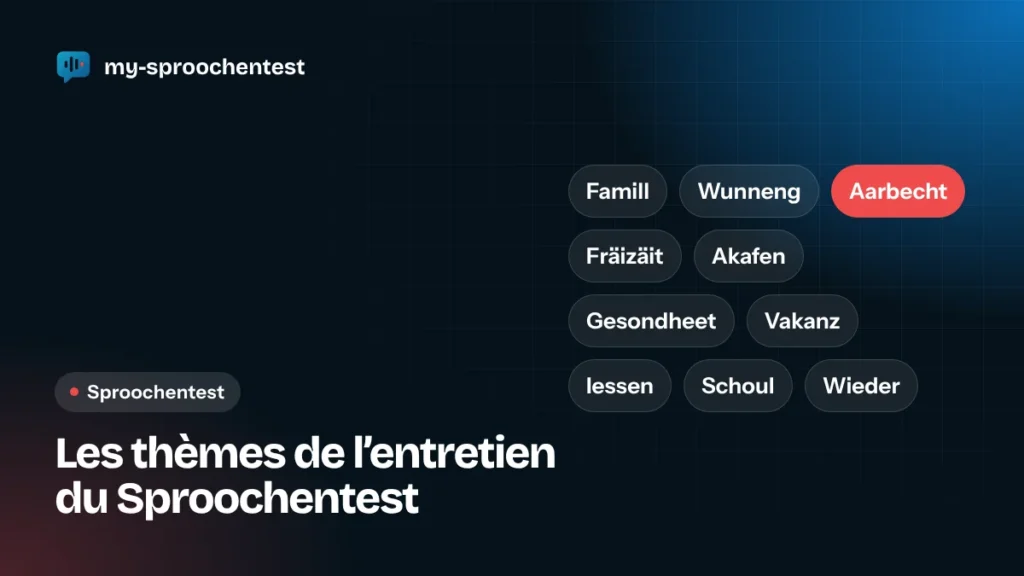
The list below is not an INLL list. It is our selection of the main areas of everyday life that cover the published examples and the subjects mentioned by the INLL (work, family, leisure). If you prepare them, you will have something to say on most subjects.
| Topic | Likely questions |
|---|---|
| Family and introductions | Who are you, where are you from, who do you live with? |
| Work and training | Your job, your working hours, your commute, what you enjoy |
| Housing and your municipality | Where do you live, what is your home like, your neighbourhood? |
| Leisure and sport | What do you do at the weekend, which sport, which films? |
| Holidays and travel | Your last holiday, your plans, seaside or mountains? |
| Shopping and food | Where do you do your shopping, what do you cook? |
| Health and well-being | Sleep, sport, doctor, stress |
| Transport | Car, bus, train, bike: pros and cons |
| Celebrations and traditions | Birthdays, weddings, celebrations in your country and in Luxembourg |
| Media and languages | Television, the internet, languages spoken at home |
How to prepare each topic
Use the same framework for each topic. It follows the structure of the INLL examples.
-
The present: your situation
Prepare 4 or 5 simple sentences about your current situation. Example for work: your job, your workplace, your working hours, your commute.
-
The past: a memory
Prepare a short story in the perfect tense: your first job, your last holiday, the last celebration you went to. Three or four sentences are enough.
-
Habits: “often”, “never”
Examiners often ask how often you do something (“Wéi dacks?”, how often?). Prepare words such as every day, once a week, rarely.
-
Your opinion: “because”
For each topic, have two opinions with reasons: what you like and why, what you do not like and why. A simple comparison also helps: here and in your home country.
-
Plans
Finish with one or two sentences about the future: what you want to do, what you would like to change.
Prepare, do not learn by heart
Do not recite a text you have learnt. The examiner asks questions that depend on your answers, and task completion is marked: you must answer the question asked. Instead, learn blocks of sentences that you can combine, and practise saying them out loud with someone who asks you questions in random order.
Choosing between the two topics
On the day, take a few seconds to choose the topic for which you know the most words, not the one that seems most interesting. If you have children, a topic about family or school will give you plenty to say; if you do sport, the leisure topic will be easier.
Vous préparez l’examen ? 500 questions au format officiel · €25
Voir la préparationA few very simple Luxembourgish phrases
These five phrases are useful for almost every topic. The words have been checked in the Lëtzebuerger Online Dictionnaire (LOD).
- Ech heeschen …: my name is … (heeschen)
- Ech wunnen zu Lëtzebuerg.: I live in Luxembourg (wunnen, zu)
- Ech schaffen an der Comptabilitéit.: I work in accounting (LOD example for schaffen)
- Ech kucke gär Filmer.: I like watching films (gär; question from the INLL example: “Kuckt Dir gär Filmer?”)
- Kënnt Dir dat wannechgelift widderhuelen?: could you repeat that, please? (widderhuelen)
The last phrase is especially useful: asking someone to repeat is normal in a conversation, and it is better than giving an answer that misses the question. Note also that “kucke” loses its “n” before “gär”: this is the Luxembourgish final “n” rule, which you will hear often.
Practise in exam conditions
The hardest part is not knowing the words, it is saying them in front of an examiner, without preparation. On my-sproochentest.lu, the Sproochentest pack offers 16 interview topics: the voice examiner asks you the questions with Luxembourgish voices, you answer out loud, and the voice corrector gives you your mark according to the exam grid, three priority corrections and a model answer to listen to. This pack opens soon. For the second part of the speaking test, read our method for succeeding at the photo description.
See the packs Try the free Vivre ensemble mini-quiz
Frequently asked questions
Is there a list of Sproochentest interview topics?
The INLL does not publish a complete list. It refers to everyday subjects (work, family, leisure…) and publishes examples, such as “Film an Televisioun”, “Schlof an Entspanung” or “Fester”.
Can you choose your topic?
Yes, between two topics offered on the day of the exam. You do not choose the topics in advance.
How long does the interview last?
5 minutes, before the description of a picture, which also lasts 5 minutes.
What should I do if I do not understand a question?
Politely ask the examiner to repeat it, for example: “Kënnt Dir dat wannechgelift widderhuelen?”. This is better than answering a different question.
La préparation complète à l’examen Vivre ensemble et le Sproochentest
€25
Paiement unique · accès 1 an · carte, Apple Pay, Google Pay
- 500 questions avec indice et explication
- 12 leçons, 4 examens blancs au format officiel
- Score par domaine après chaque contrôle