The Vivre ensemble exam in Luxembourg: format, registration and preparation
A 24-hour course or a 40-question multiple-choice exam: everything about the Vivre ensemble exam, its format, registration and the best way to prepare.
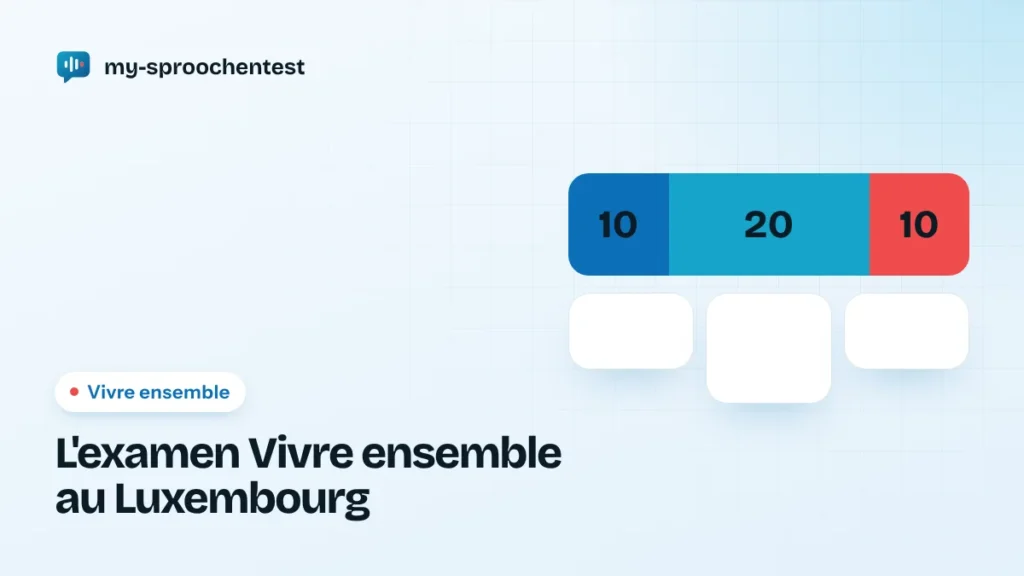
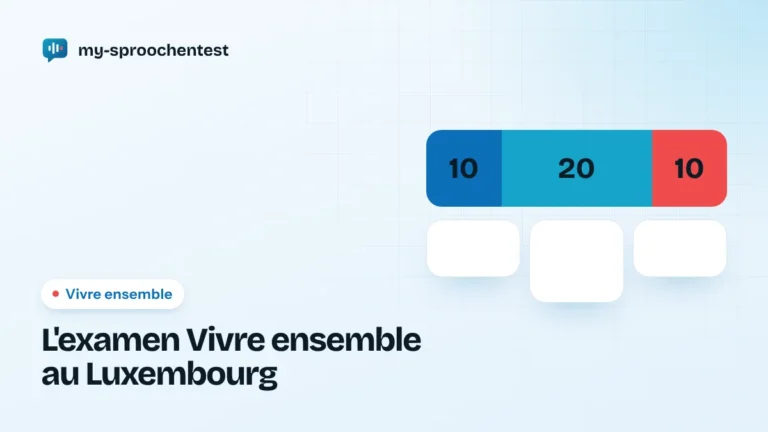
For naturalisation and several option cases, you must prove your knowledge of Luxembourg: either by attending the “Vivre ensemble au Grand-Duché de Luxembourg” course (Living together in the Grand Duchy of Luxembourg, 24 hours) or by passing the exam on its content. The exam has 40 multiple-choice questions, taken on a computer in Esch-Belval: 10 on fundamental rights, 20 on State and municipal institutions, 10 on history and European integration.
In short: a 24-hour course or a 40-question multiple-choice exam (10/20/10), whichever you prefer. Both lead to the same certificate, issued by the Service de la formation des adultes (SFA, the adult education department). Registration for the course is free and done online. The pass mark for the exam is not published on the pages we consulted.
Course or exam: two paths to the same certificate
According to the Ministry of Education, the certificate can be obtained in two ways: by attending the 24 hours of classes or by passing the exam. The course is divided into three areas:
| Area | Course hours | Exam questions |
|---|---|---|
| Fundamental rights of citizens | 6 h | 10 |
| State and municipal institutions | 12 h | 20 |
| History of the Grand Duchy and European integration | 6 h | 10 |
| Total | 24 h | 40 |
The course
The course takes place in person in Luxembourg-Hollerich, Esch-Belval and Diekirch. Classes in the north of the country are announced for the end of 2026. Online classes are offered in English. The course suits you if you like learning in a group or find it hard to revise on your own.
The exam
The exam suits you if you prefer to revise at your own pace and sit it in one go. It is taken on a computer in Esch-Belval. Guichet.public.lu specifies that it consists of multiple-choice or binary-choice questions.
The exam format in detail
The 40 questions follow the distribution of course hours: half are about institutions. This is the area to work on first: Chamber of Deputies, government, Grand Duke, Council of State, justice, municipalities, elections.
The pass mark appears neither on the ministry’s page nor on guichet.public.lu. Be wary of figures that circulate without a source. For practice, our mock exam applies a practice threshold of 70%.
Watch out for the revised Constitution, which came into force on 1 July 2023: the numbering of articles and some rules have changed. Revise with up-to-date materials.
Registration, venue and fees
- Where to register: on the Vivre ensemble registration platform. Online registration is final.
- Contact: Service de la formation des adultes, sfa@men.lu, (+352) 8002-4488, Monday to Friday, 8 am to 12 noon and 1 pm to 5 pm.
- Exam venue: Esch-Belval.
- Fees: guichet.public.lu states that registration for the course is free. The pages consulted do not mention a fee for the exam; check when you register.
Possible exemptions
Two situations are provided for by guichet.public.lu:
- Full exemption from the course and the exam if your physical or mental condition prevents you from acquiring this knowledge. The request is made to the Minister of Justice, with a certificate from a medical specialist.
- Exemption from the “history and European integration” module, granted automatically if you hold a certificate for the civic instruction courses of the Welcome and Integration Contract, or for a module of at least 6 hours of the citizens’ pact. If you only take the exam without attending the modules, this exemption does not apply.
All cases are detailed in our article Who is exempt from the Sproochentest and the Vivre ensemble course?
Vous préparez l’examen ? 500 questions au format officiel · €25
Voir la préparationSample questions
Here are three questions in the style of the exam, one per area. We wrote them ourselves on the basis of public sources.
- Fundamental rights — According to the Constitution, who has the right to education? Children of Luxembourgish nationality / Residents holding a residence permit / Everyone / Children of taxpayers. Answer: everyone (Constitution, Article 33).
- Institutions — How many members does the Chamber of Deputies have? 45 / 60 / 64 / 75. Answer: 60 members, elected for five years (Constitution, Article 63).
- History and Europe — In what year did Luxembourg give up its neutrality? 1939 / 1948 / 1957 / 1972. Answer: 1948, before joining NATO in 1949 (À propos de l’histoire du Luxembourg, in French).
Test yourself now with our free 10-question mini-quiz:
Test yourself for free. Vivre ensemble: 10 free questions with the answer and the explanation. →
The most common pitfalls
Mixing up the institutions
Who votes on laws, who gives an opinion on bills, who appoints the government, who runs the municipality: questions on institutions often play on these differences. Make yourself a simple table: “institution, composition, role”.
Revising with outdated materials
A summary written before the 2023 Constitution, or before a change of head of state or government, can mislead you. Date your materials and check the facts that change over time.
Reading too quickly
The answer options are sometimes similar. Read the question to the end, eliminate the impossible answers first, then choose between the remaining ones.
How to prepare effectively
-
Start with the institutions
They account for 20 of the 40 questions. Learn the role of each institution and who does what.
-
Work area by area
Revise one area at a time, with an explanation for each mistake. Understanding beats learning by heart.
-
Take mock exams
Practise with 40 questions in the same distribution, against the clock. Spot the questions you often get wrong.
-
Check your sources
Prefer up-to-date public texts, especially the 2023 Constitution, to old summaries.
Our Vivre ensemble pack, available now for €25, brings together 500 multiple-choice questions in 3 modules, an immediate explanation after each answer and unlimited 40-question mock exams (10/20/10, timer, corrections at the end). One-year access, one-off payment. Try the free mini-quiz first, then compare our packs.
To see where the exam fits into the overall process, also read The requirements for Luxembourgish citizenship.
Frequently asked questions
Do you have to attend the course and take the exam?
No. The certificate is obtained either by attending the 24 hours of classes or by passing the exam. You choose one of the two.
How many questions are there in the Vivre ensemble exam?
40 questions: 10 on fundamental rights, 20 on State and municipal institutions, 10 on the history of Luxembourg and European integration.
Where is the exam held?
According to the Ministry of Education, the exam is held in Esch-Belval, on a computer. You register online on the Vivre ensemble platform.
What mark do you need to pass?
The pass mark is not stated on the ministry and guichet.public.lu pages we consulted. Our mock exam applies a practice threshold of 70%.
La préparation complète à l’examen Vivre ensemble et le Sproochentest
€25
Paiement unique · accès 1 an · carte, Apple Pay, Google Pay
- 500 questions avec indice et explication
- 12 leçons, 4 examens blancs au format officiel
- Score par domaine après chaque contrôle