Sproochentest level: A2 for speaking and B1 for listening explained
The Sproochentest requires level A2 for speaking and level B1 for listening. Here is what these two levels mean in practice, with examples of what you need to be able to do on exam day.
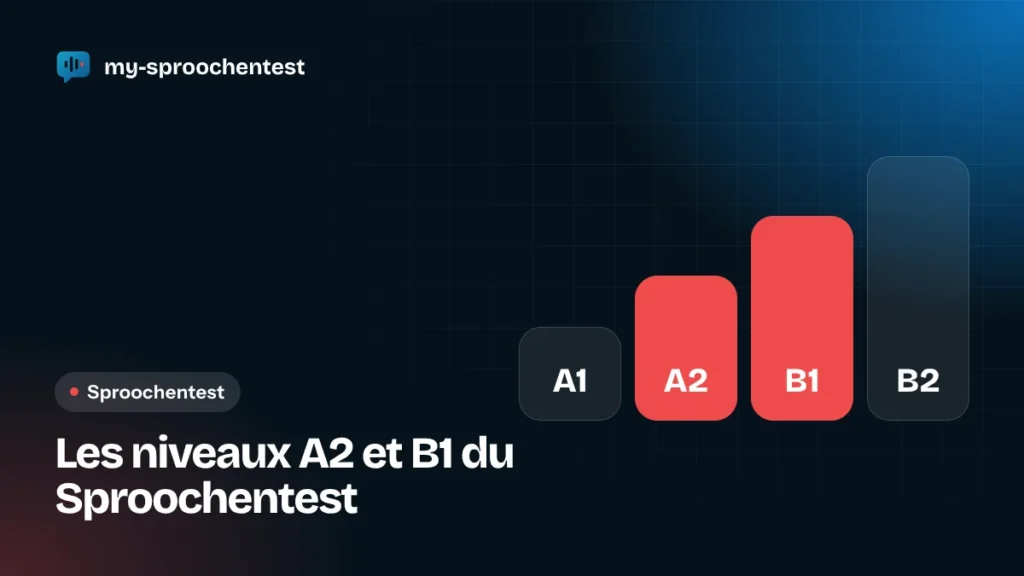
The Sproochentest requires two different levels of the Common European Framework of Reference for Languages (CEFR): level A2 for speaking and level B1 for listening comprehension. In practice, you need to be able to talk simply about yourself, your family, your work and your daily life, and to understand the main points of a radio message or a conversation in standard Luxembourgish. There is no writing test.
In brief. A2 for speaking: introduce yourself, talk simply about your family, your living conditions, your education or your job, and describe and compare people, things or activities in simple terms. B1 for listening: understand the main points of clear, standard speech and the essentials of radio or TV programmes on current affairs or on personal or professional topics. The listening level required is therefore higher than the speaking level.
Why two different levels?
The Sproochentest assesses the language of everyday life. The INLL’s Sproochentest page sets level A2 for speaking and level B1 for listening comprehension. This makes sense: in real life, we almost always understand more than we can say. You can follow a conversation between neighbours, a radio announcement or a doctor’s explanation, even if you reply in short sentences.
The good news: you do not need perfect Luxembourgish. The A2 speaking test accepts simple sentences and a few mistakes, as long as you make yourself understood and really answer the questions. For the full exam format, read our overview of the Sproochentest.
Level A2 for speaking: what it means
Guichet.lu sums up the expected A2 level as follows: being able to introduce yourself and talk simply about your family, your living conditions, your education or your job, and to describe and compare people, things or activities in simple terms.
What you need to be able to do, in practice
Here are concrete examples of what this description covers. They do not come from an INLL list: they are typical A2-level situations.
- Introduce yourself: your name, your country of origin, how long you have lived in Luxembourg, where you live.
- Talk about your family: who lives with you, what your children do, where your family lives.
- Describe your work or your training: your job, your working hours, how you get to work, what you like or dislike.
- Talk simply about the past: your last weekend, your last holiday, a recent celebration.
- Talk about your plans: what you will do this summer, what you would like to change.
- Give a simple opinion and justify it: “I prefer… because…”.
- Describe and compare: a picture, two homes, life here and in your home country.
The tenses and structures to master
The sample interviews published by the INLL often follow the same thread: general questions, then questions about the past, the present situation and future plans. The example “Schlof an Entspanung” (sleep and relaxation) is built this way, with questions beginning with “Firwat?” (why?). To follow this thread, practise above all:
- using the present tense without hesitating;
- talking about the past using the perfect tense, with the auxiliaries hunn and sinn;
- talking about the future simply, for example with a time expression (“next year…”);
- linking your ideas with simple words: and, but, because, then;
- justifying a preference, as the question “why?” comes up often.
What A2 does not require
You are not expected to give a long, reasoned speech, use technical vocabulary or speak with flawless grammar. The assessment grid that the INLL publishes with its examples marks four criteria (vocabulary, morphosyntax, phonetics, task completion), each from 0 to 5, plus an overall assessment by the examiner who leads the interview. Task completion counts as much as grammar: a simple but complete answer is better than an ambitious, unfinished sentence.
Level B1 for listening: what it means
According to Guichet.lu, B1 listening comprehension means understanding the main points of clear, standard speech, as well as the essentials of radio or TV programmes on current affairs or on topics of personal or professional interest.
The three types of recordings
On exam day, you listen to three recordings, described by the INLL:
- a piece of news or a radio message: for example a short news item, an announcement, practical information;
- an everyday conversation between two people;
- a discussion or a presentation on a set topic, often longer.
After each recording, you answer multiple-choice questions on a tablet. The answer sheet of the example published by the INLL states that there is always only one correct answer. The test lasts 35 minutes in total.
What you need to be able to do, in practice
- Identify the main information: what is it about, who is speaking, where, when?
- Understand numbers: times, dates, prices, phone numbers, durations. These are details where it is easy to slip up.
- Follow a change of mind: “first… but in the end…”.
- Understand the intention: someone is suggesting, refusing, apologising, complaining.
- Do not panic over an unknown word: B1 requires the main points, not every word.
Vous préparez l’examen ? 500 questions au format officiel · €25
Voir la préparationHow to tell if you have the level
Try a simple test, out loud and without notes:
- Talk for two minutes about your last weekend, then for two minutes about your plans.
- Describe a photo on your phone for one minute: who, where, what.
- Listen to the sample recording published by the INLL and answer the questions, then check with the answer key.
If you keep talking without long silences and find most of the correct answers, you are on the right track. The sample tests (interviews, pictures, recording, answer sheet and answer key) are on the INLL page.
How to progress towards A2 and B1
For speaking
- Prepare a one-minute introduction of yourself, then expand it every week.
- Work by everyday topic: family, work, housing, leisure, holidays, health. Our article on the interview topics gives you a method.
- Record yourself and listen back: you will hear your hesitations and pronunciation mistakes.
For listening
- Listen to a little Luxembourgish every day, even 10 minutes, on your commute.
- Practise with multiple-choice questions: read the questions first, then listen.
- Note down numbers and key words while listening during practice.
On my-sproochentest.lu, you work on exactly these two levels: B1 listening with Luxembourgish voices, and A2 speaking with the voice corrector, which gives you your mark according to the exam grid and a model answer to imitate. The Sproochentest pack opens soon. If you are also preparing for the Vivre ensemble exam, the free mini-quiz is already available.
Discover the packs Take the free mini-quiz
Frequently asked questions
What level do you need to pass the Sproochentest?
CEFR level A2 for speaking and level B1 for listening comprehension, according to the INLL.
Do you need to be able to write in Luxembourgish?
No. The Sproochentest consists of a speaking test and a listening comprehension test. You tick your listening answers on a tablet, without writing any text.
Is level A2 hard to reach?
It is a basic level: talking simply about yourself and your daily life. The difficulty depends mainly on how much speaking practice you have. We discuss this in our article on how difficult the Sproochentest is.
Why is listening at level B1?
Because we generally understand more than we can say. The test checks that you can follow the main points of a radio message or an everyday conversation.
La préparation complète à l’examen Vivre ensemble et le Sproochentest
€25
Paiement unique · accès 1 an · carte, Apple Pay, Google Pay
- 500 questions avec indice et explication
- 12 leçons, 4 examens blancs au format officiel
- Score par domaine après chaque contrôle